| Grade | Points |
|---|---|
| O (Outstanding) | 10 |
| A+ (Excellent) | 9 |
| A (Very Good) | 8 |
| B+ (Good) | 7 |
| B (Above Avg) | 6 |
| C (Average) | 5 |
| P (Pass) | 4 |
| F (Fail) | 0 |
Need to convert your CGPA into a percentage? Use our instant university-specific converter.
A CGPA calculator should do one thing well: give you an accurate number in seconds, without you having to do the math by hand. That's what this tool is built for: you just enter your grades or SGPA, and get your overall CGPA in no time, in the same way your university does it.
What Is CGPA?
CGPA (Cumulative Grade Point Average) measures your academic performance across an entire course, not just one semester. Colleges use it for final transcripts, placement eligibility, and higher-education applications, which is why getting it right matters more than getting it fast.
The CGPA Formula
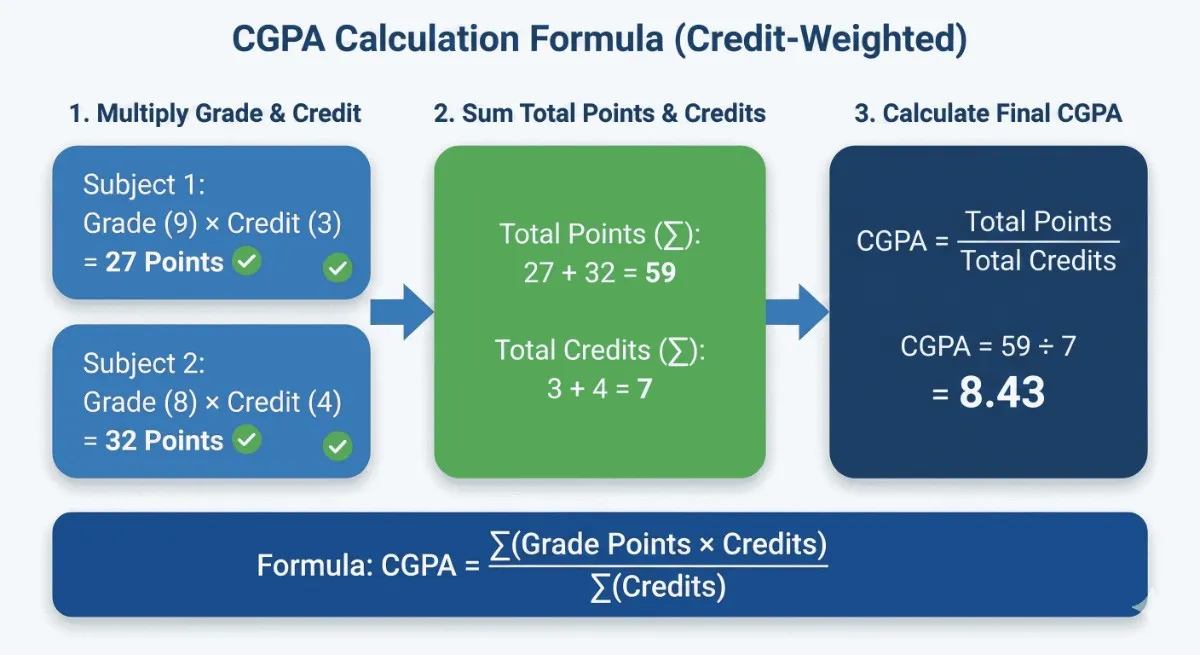
Most Indian universities use a credit-weighted average, not a simple average. That distinction matters if some of your semesters carried more credits than others.
| Method | Formula | When to Use |
|---|---|---|
| Simple average | Sum of SGPA ÷ Number of semesters | Only if every semester has equal credits |
| Credit-weighted | Σ(SGPA × Credits) ÷ Σ Credits | Official method for most transcripts |
If you're unsure which applies to you, check your institution's grading circular, but the credit-weighted method is safe to use by default, and it's what this calculator uses automatically.
Overall, Total, Average, or Aggregate CGPA: What's the Difference?
Students search for this concept using different words, and it causes real confusion. Here's the honest answer: for most universities, overall CGPA, total CGPA, and aggregate CGPA mean the same thing: your cumulative score across all completed semesters.
Average CGPA is the one exception worth knowing. It's sometimes used specifically to mean the simple, non-credit-weighted average, adding up all the SGPA and dividing by the number of semesters. If your semesters have different credit loads, this can give a slightly different number than your official CGPA. When in doubt, use the credit-weighted method above.
How to Calculate Overall CGPA of All Semesters
- Multiply each semester's SGPA by that semester's total credits.
- Add up all the results to get your total grade points.
- Divide by the total number of credits across all semesters.
Example: How to calculate overall CGPA of 6 semesters:
- Semester 1: 8.0 SGPA × 20 Credits = 160 Points
- Semester 2: 7.5 SGPA × 22 Credits = 165 Points
- Semester 3: 8.2 SGPA × 20 Credits = 164 Points
- Semester 4: 7.8 SGPA × 25 Credits = 195 Points
- Semester 5: 8.5 SGPA × 20 Credits = 170 Points
- Semester 6: 8.0 SGPA × 23 Credits = 184 Points
1. Total Grade Points: 160 + 165 + 164 + 195 + 170 + 184 = 1038
2. Total Credits: 20 + 22 + 20 + 25 + 20 + 23 = 130
Prefer not to do this by hand? Use the calculator above, switch to "Using SGPA" mode, enter each semester's SGPA and credits, and your overall CGPA appears instantly.
Already Have Your SGPA?
If you haven't calculated your semester SGPA yet, do that first using our SGPA calculator, then bring that number here. This page focuses on combining semesters into one final CGPA, not on grading individual subjects.
Checking One Semester Instead of All of Them?
If you only need a single semester's CGPA (not your full academic record), the same credit-weighted formula applies; just run it for that semester's subjects alone using "Using Grades" mode above.
Frequently Asked Questions (FAQs)
Can my CGPA be higher than my highest SGPA?
No. Your overall CGPA will always fall between your lowest and highest semester SGPA; it's a weighted average, so it can never exceed your best semester's score.
Does aggregate CGPA include a semester I failed or repeated?
Yes, typically. Most universities include repeated-semester results in your aggregate calculation, though the exact rule (whether they average the attempts or take the latest) varies by institution; check your specific university's regulations if this applies to you.
Do all universities calculate CGPA the same way?
Mostly, but not universally. The credit-weighted formula is the most common standard, but a few institutions use simple averages or apply their own rounding rules. If your result differs slightly from your official transcript, that's usually why.
Is a 10-point CGPA the same as a 4.0 GPA?
No, they're different scales. A 10-point CGPA doesn't convert directly to a 4.0 GPA using a fixed multiplier; the conversion depends on your institution's specific grading policy, so check with your university or the receiving institution before using an estimate on official documents.
Why might my calculated CGPA differ slightly from my transcript?
Small mismatches usually come from rounding rules, backlog subjects, or non-credit courses your university excludes from the official calculation. The formula itself is standard — the inputs are where discrepancies usually start.
In Short
Whether you call it overall, total, or aggregate CGPA, the credit-weighted formula above is the one that matches most official transcripts.